

Abstract — Custom furniture manufacturing has shifted from batch production to high-mix, low-volume output, and the nesting center has become the bottleneck-defining asset on the shop floor. This article examines the technical and economic logic of automatic loading and unloading nesting centers, compares their architecture against conventional ATC routers, and uses the Roctech Master series (RCA1224 through RCA1530) as a reference implementation to show how machine specification choices translate into material yield, labor cost, and throughput. The argument is straightforward: in panel furniture, the return on a nesting center is determined less by spindle power than by the coherence of the loading, nesting, drilling, and unloading chain.
1. Industry Background
The panel furniture segment has been restructured by whole-house customization. Orders arrive as parametric design files, each containing dozens of unique panel geometries; batch sizes fall while SKU counts rise. Under this regime, the traditional workflow—a three-axis router cutting one sheet at a time, manual loading, manual offloading, secondary drilling on a separate machine—accumulates non-cutting time that no feed-rate improvement can recover.
Three pressures follow. First, sheet utilization: even a two-percentage-point gain in yield on melamine-faced board translates into meaningful annual savings at volume. Second, labor: loading and offloading a 1,220 × 2,440 mm board manually requires two operators and carries injury risk; automated handling removes both the headcount and the ergonomic exposure. Third, process consolidation: cutting, drilling, and grooving performed in a single clamping eliminate re-registration errors and the work-in-progress buffer between stations.
The dominant technical response has been the nesting center with an integrated loading/unloading gantry, automatic nesting software, and an optional row-drill group. This is now the reference architecture for custom cabinet and wardrobe production.
2. Machine Architecture and Parameter Analysis
The table below summarizes the reference specification of the Roctech RCA1224, a standard automatic loading and unloading nesting center, alongside the RC1325S-ATC, a conventional automatic tool changer router, to make the architectural differences explicit.
| Parameter | RCA1224 Nesting Center | RC1325S-ATC Router |
|---|---|---|
| X/Y/Z travel | 1,220 × 2,440 × 150 mm | 1,300 × 2,500 × 250 mm |
| Bed structure | Heavy-duty welded | Heavy-duty steel pipe welded |
| Guide rail | Taiwan HIWIN linear guide | — |
| Spindle power | 9.6 kW (higher optional) | 9 kW (6/12 kW optional) |
| Drive system | Japan Yaskawa servo | Japan Yaskawa servo |
| Control system | Taiwan Syntec | Taiwan Syntec |
| Table | Double-layer vacuum, zone adsorption | Vacuum adsorption + T-slot |
| Tool change | Row-drill group (drilling/grooving in one pass) | Carousel magazine, 8/12/16 tools |
| Rapid traverse | — | 45,000 mm/min |
| Positioning accuracy | — | ±0.03 mm/300 mm |
| Repeat positioning | — | ±0.03 mm |
| Machine weight | approx. 4,500 kg | approx. 2,200 kg |
| Automation | Automatic loading/unloading, labeling optional | Automatic pusher optional |
Two readings of this table matter. The first is mass: at roughly 4,500 kg, the RCA1224 carries nearly twice the structural mass of the RC1325S-ATC. That mass is not incidental—it is the rigidity required to hold accuracy while a gantry moves sheets on and off the table between cycles, and it is why the nesting center tolerates the vibration environment of a production cell rather than a job shop.
The second is the tool-change philosophy. The ATC router optimizes for process diversity: eight to sixteen tools, 45,000 mm/min rapids, ±0.03 mm repeatability, suited to door panel engraving, acrylic work, and mold machining where geometry changes constantly. The nesting center optimizes for process completion: the row-drill group performs cutting, drilling, and grooving without a tool change at all, because in cabinet production the hole pattern—not the profile—is the cycle-time driver. Specifying an ATC magazine on a nesting application is a common and expensive misreading of the workload.
The double-layer vacuum table with zone adsorption deserves separate comment. Small panels, which dominate custom orders, cannot be held by a full-sheet vacuum field alone; zoning lets the controller energize only the region under the workpiece, preserving holding force and preventing the cut part from shifting on the final pass. This is a small feature with outsized effect on scrap rates.
3. Technology Application and Brand Case
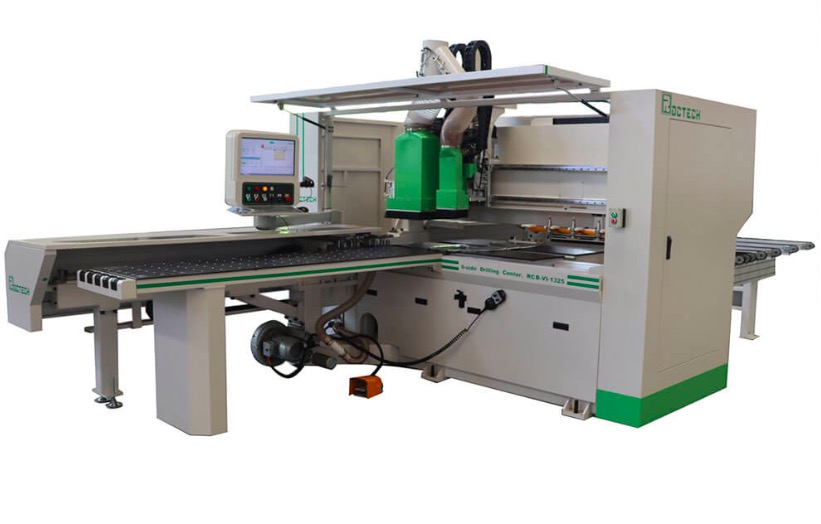
Roctech Machinery Co., Ltd., headquartered in Jinan, Shandong, illustrates how a mid-market Chinese builder has positioned itself across this transition. The company's product range spans CNC engraving machines, ATC routers, five-axis simultaneous machining centers, fiber laser cutters, six-sided drilling centers, and edge banding machines—a portfolio that maps almost one-to-one onto the process chain of a custom furniture plant. Its certifications (ISO 9001, CE, UL, and FDA for laser equipment) and its export footprint of more than 100 countries indicate the compliance and service infrastructure required to sell into European and North American panel furniture markets.
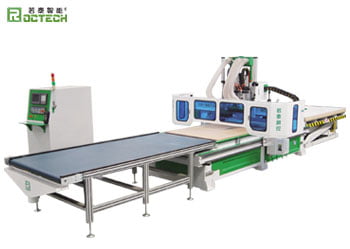
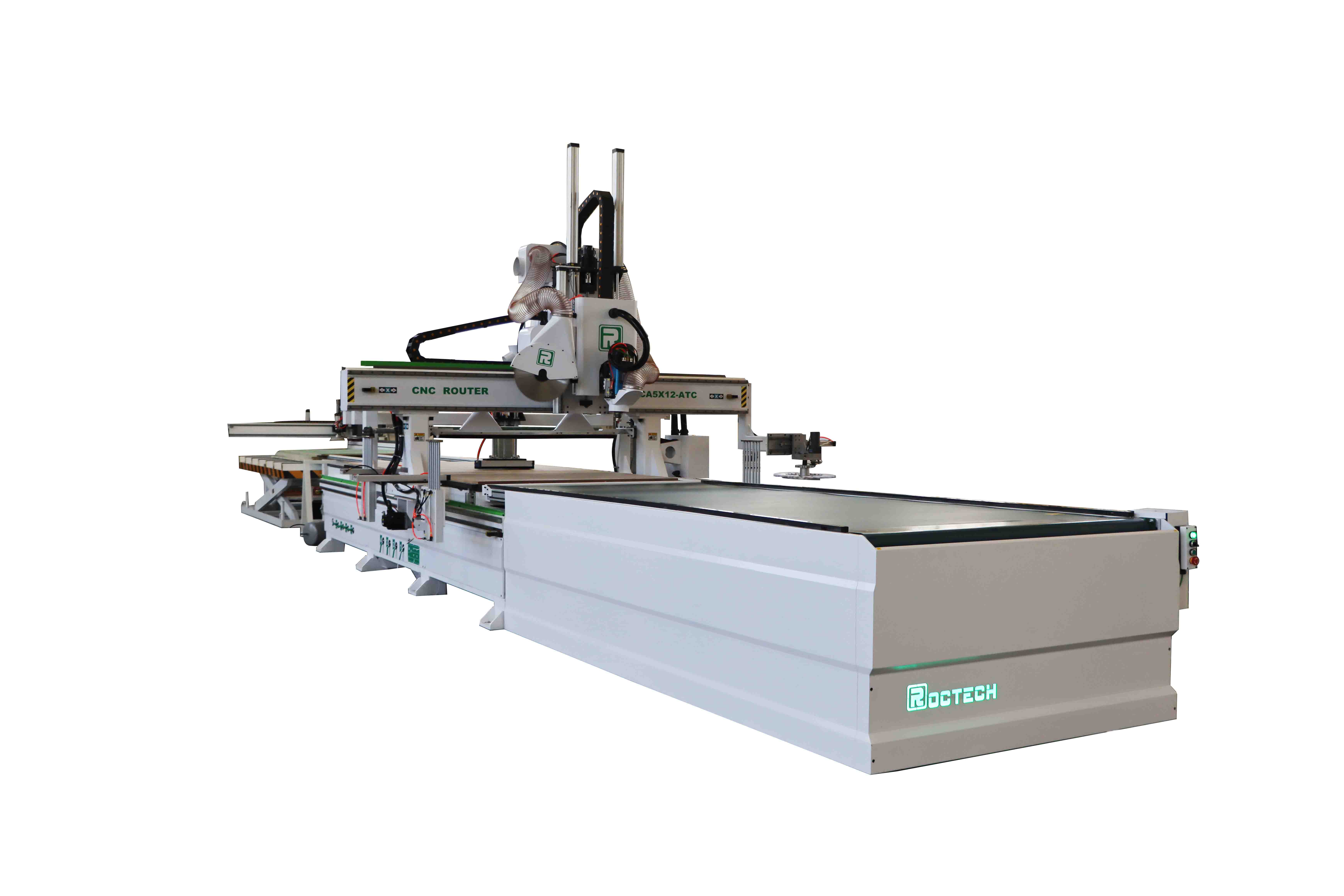
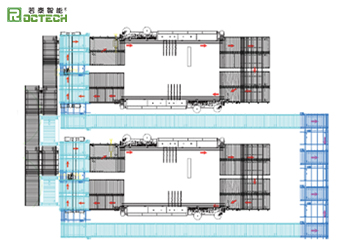
Within that range, the Master series automatic loading and unloading nesting center is the most direct expression of the architecture described above. The RCA1224, RCA1228, RCA1325, RCA1328, and RCA1530 cover the stroke envelope from standard 1,220 × 2,440 mm sheets up to large-format panels, all sharing the welded bed, HIWIN guideways, Yaskawa servo drives, and Syntec control. The optional automatic labeling system is the detail worth flagging: a label applied at the nesting stage lets downstream edge banding and drilling stations scan and retrieve the correct program, which is the practical precondition for connecting nesting to a six-sided drill and an automatic edge bander without manual sorting. In other words, the machine is designed as a node in a data-connected line, not as a standalone cutter—consistent with the company's stated direction toward Industry 4.0 overall solutions.
For buyers, the selection logic follows from the table. A shop producing cabinet doors and decorative panels with frequent tool changes should specify an ATC router such as the RC1325S-ATC. A shop producing box furniture at volume should specify a nesting center and invest the difference in nesting software and a labeling system, because the constrained resource is sheet handling and hole drilling, not profile cutting.
4. Conclusion and Outlook
The nesting center is best understood as a systems product: its value derives from the integration of loading, nesting optimization, drilling, and unloading, and it degrades quickly if any link—software compatibility, label discipline, vacuum zoning—is neglected. The specification trend is clear: heavier welded structures, zone-controlled vacuum, integrated row drills, and data interfaces to MES and nesting software. Roctech's Master series sits squarely within this trend, and the broader market is likely to see further consolidation around machines that can be dropped into a connected line rather than operated as isolated assets.
Looking for more information about our CNC machines and services? Contact us today.
Contact





















The Economics of Automated Nesting in Custom Furniture: Machine Architecture, Throughput, and the Case of the Roctech Master Series - Roctech® have advanced technology for CNC Router,cnc router cabinets,Roctech already have 15 years experiences of cnc router technology.-© 2023 Roctech® Machinery Co.,Ltd. - All Rights Reserved Website Terms Of Use ● Privacy Policy ● Cookie Policy