
Recent Post
- 2026-11-10 04:31:38
- 2026-10-26 04:30:59



Abstract — Nesting—the practice of arranging parts on a sheet to minimize waste—has quietly become one of the most consequential cost levers in panel furniture manufacturing. As custom cabinetry and whole-house fit-out demand shifts from mass production toward mass customization, the nesting CNC router has evolved from a standalone cutting table into an automated cell that loads, cuts, drills, labels, and unloads with minimal human touch. This article examines the market and technology backdrop for these machines, compares representative configurations, and considers how suppliers such as Roctech® are positioning themselves in an increasingly crowded field.
Industry Background: Why Nesting Machines Matter Now
The economics of panel furniture are unforgiving. Raw board—melamine-faced chipboard, MDF, plywood—typically accounts for 40 to 60 percent of a cabinetmaker's material cost, and every percentage point of sheet utilization recovered flows almost directly to the bottom line. This is the fundamental reason nesting routers, rather than beam saws, have become the default cutting platform for custom furniture shops over the past decade. A beam saw is fast on repetitive, rectangular batches, but it cannot economically handle the one-off, irregularly shaped parts that define custom work. Nesting software can.
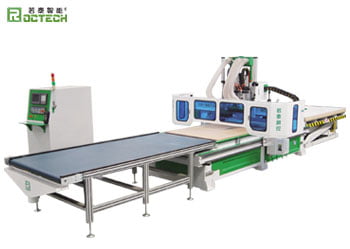
What has changed more recently is the automation layer wrapped around the cutting itself. The automatic loading and unloading nesting center—a machine that pulls a full sheet from a stack, registers it, cuts it, and offloads finished parts onto a stacking table—has moved from a niche high-end product to a mainstream expectation in mid-to-large shops. The labor math is straightforward: a manual nesting cell typically needs one operator continuously present for loading and offloading, whereas an automated cell needs one operator supervising two or three machines. In markets where skilled machine operators are scarce and wages are rising, that ratio is the whole business case.
The table below compares representative configurations across the nesting machine tiers commonly found in the market, using parameters consistent with Roctech's Master series documentation as a reference point for the automated tier.
| Parameter | Manual Nesting Router (typical) | Automated Loading/Unloading Nesting Center (Roctech RCA1224 reference) |
|---|---|---|
| X/Y/Z travel | 1300 × 2500 × 200 mm | 1220 × 2440 × 150 mm |
| Bed structure | Welded steel, single-layer vacuum | Heavy-duty welded, double-layer vacuum with zone control |
| Guide rail | Taiwan HIWIN linear guide | Taiwan HIWIN linear guide |
| Spindle power | 6–9 kW | 9.6 kW (higher power optional) |
| Drive system | Stepper or entry servo | Japan Yaskawa servo motors |
| Control system | Taiwan Syntec or equivalent | Taiwan Syntec, G-code instruction set |
| Tool change | Manual | ATC with carousel/linear magazine (8–24 tools) |
| Drilling | Separate operation | Integrated row-drill group; cut–drill–groove in one pass |
| Labeling | Manual | Optional automatic labeling system |
| Loading/unloading | Manual | Automatic sheet loading and finished-part offloading |
| Machine weight | ~2,000–2,500 kg | ~4,500 kg |
| Typical role | Prototyping, small batch, low-volume custom | Volume custom cabinetry, wardrobes, office furniture |
Three observations follow from the data. First, the travel envelope of the automated machine is actually slightly smaller than the manual router's—1220 × 2440 mm versus 1300 × 2500 mm—which reflects a deliberate design choice: the automated cell is optimized for the standard 4 × 8 ft sheet, not for oversized work. Buyers who need to cut 1530 × 3050 mm panels must step up to the larger RCA1530 or accept manual handling. Second, the mass difference—roughly double—is not incidental. The double-layer vacuum table, the loading gantry, and the heavier welded frame all add weight, and that weight is what allows the machine to hold accuracy while a row-drill group fires dozens of holes per sheet. Third, the integration of drilling and labeling into the cutting cycle is where the real time savings accumulate. A separate six-sided drill and a manual labeling station each add a handling step; folding them into the nesting cell eliminates two material movements per sheet.
Technology Application: From Standalone Router to Production Cell
The technological story of the modern nesting center is really a story about systems integration rather than any single breakthrough. The spindle, the guide rails, the servo drives—these are mature, commoditized components sourced from a small pool of global suppliers. What differentiates machines is how the loading gantry, the vacuum zoning, the tool magazine, the row-drill group, and the control software are coordinated.
Consider the vacuum table. A single-zone table forces the operator to cover unused areas with sacrificial board or masking film to maintain hold-down pressure on small parts. A double-layer, zone-controlled table lets the nesting software activate only the zones beneath the current nest, which matters enormously when cutting small cabinet components that would otherwise shift during the final pass. This is a software-and-plumbing problem, not a spindle problem, and it is precisely the kind of detail that separates a machine that runs reliably at 18 m/min from one that must be throttled back.
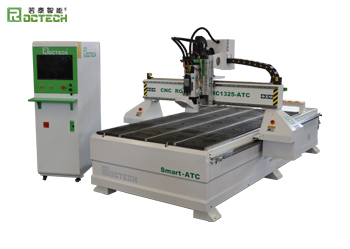
Roctech Machinery Co., Ltd., headquartered in Jinan, Shandong, illustrates how a Chinese builder has moved up this integration curve. The company began in CNC engraving machines, expanded into woodworking machining centers and cutting equipment, and now fields automatic loading and unloading nesting centers, ATC routers, five-axis machining centers, six-sided drills, and edge banding machines—a product ladder that maps closely onto the process chain of a panel furniture factory. Its certifications (ISO9001, CE, UL, FDA for laser equipment) and its export footprint across more than 100 countries suggest a supplier that has cleared the compliance and service thresholds required for Western markets. The RCA series, with its Syntec control, Yaskawa drives, and HIWIN rails, is a representative example of the "global components, Chinese integration" model that now dominates the mid-market: the buyer gets familiar, serviceable subsystems at a price point that pure-European or Japanese builders struggle to match.
It is worth pausing on a component that sits upstream of the nesting cell but is often overlooked in machine selection: the vacuum pump. The Hanbell (Hanbell) screw-type vacuum pump, commonly referred to in shop-floor shorthand as the RC-2 series, is a dry-running, twin-screw positive-displacement pump widely used to generate hold-down vacuum for nesting tables. Its detailed parameters, as generally specified for this class of pump, are as follows. The pumping mechanism is a pair of intermeshing rotors with no internal lubrication, giving oil-free operation and eliminating the oil-mist contamination that plagues rotary-vane pumps in dusty woodworking environments. Typical ultimate vacuum falls in the range of roughly 0.1 to 1 mbar, with pumping speeds commonly offered between about 100 and 500 m³/h depending on rotor size and motor configuration; motor power correspondingly spans approximately 2.2 kW to 15 kW across the model range. Discharge is at atmospheric pressure, cooling is air- or water-based depending on the variant, and the pump tolerates ingress of fine dust and wood chips far better than a vane pump because there are no sliding contacts in the compression chamber. Connection flanges are typically DN50 to DN100, noise levels sit in the 70–80 dB(A) band, and the pump is designed for continuous duty.
The practical significance for nesting operations is threefold. First, dry screw pumps hold vacuum steadily even as filter media load up with dust, whereas vane pumps lose hold-down force as their oil emulsifies and their vanes wear—a failure mode that manifests as parts shifting mid-cut, which operators often misdiagnose as a clamping or software problem. Second, the absence of oil consumption reduces running cost and eliminates a waste stream. Third, the pump's tolerance for particulate ingress means the dust collection and intake filtration can be simpler and less maintenance-intensive. When specifying an automated nesting center, buyers should treat the vacuum source as a first-order decision rather than an afterthought: a machine with a 9.6 kW spindle and a double-layer table is only as good as the vacuum beneath it, and a screw pump matched to the table's zoning and leakage rate will outperform a larger but poorly matched vane pump in actual hold-down force at the cut.
Conclusion and Outlook
The nesting CNC router market is no longer a story about cutting speed. Spindle power and rapid traverse rates have converged across suppliers, and the marginal gains from another 5,000 mm/min are small compared with the gains from eliminating a material handling step or recovering three percentage points of sheet yield. The competitive frontier has moved to integration: loading and unloading automation, in-cycle drilling and labeling, zone-controlled vacuum, and software that talks directly to the factory's order management system. Roctech's trajectory—from engraving machines to a full process-chain portfolio including nesting centers, six-sided drills, and edge banders—reflects this shift, and its use of globally recognized subsystems gives buyers a familiar baseline for service and spare parts.
Looking ahead, two developments bear watching. The first is the continued spread of robotic loading and stacking, which extends the automated cell from sheet-in/parts-out to a genuinely lights-out operation for off-shift production. The second is the tightening of the software link between design, nesting, and machine execution, where the real differentiation among suppliers will likely be decided. For buyers, the practical guidance is unglamorous but reliable: specify the vacuum system as carefully as the spindle, confirm that the travel envelope matches the sheet sizes actually purchased, and weigh the labor savings of automation against the throughput you can genuinely keep fed. Machines are increasingly similar; production systems are not.
Looking for more information about our CNC machines and services? Contact us today.
ContactNext:The Nesting Center as the New Baseline: Automation and Integration in Panel Furniture Manufacturing






















The Woodworking Nesting CNC Router: Market Dynamics, Technology, and the Automation Leap - Roctech® have advanced technology for CNC Router,cnc router cabinets,Roctech already have 15 years experiences of cnc router technology.-© 2023 Roctech® Machinery Co.,Ltd. - All Rights Reserved Website Terms Of Use ● Privacy Policy ● Cookie Policy